
AEO gets you cited. SEO gets you ranked. Right now, most founders only have one.
Every day, thousands of customers ask ChatGPT who they should hire.
Most businesses never even realize those conversations are happening.
If ChatGPT doesn't know your company exists, you can't win customers you'll never even know you lost.
This isn't a Google ranking problem. Your SEO might be excellent. The issue is that AI search runs on a completely different set of signals. Most businesses haven't touched a single one.
That's the opportunity. Only 20% of businesses have active strategies for AI search visibility. The founders who show up in ChatGPT today didn't get there by luck. They got there by doing a specific set of things you probably haven't done yet.
This checklist is those things.
Wait. Isn't AEO Just SEO With a New Name?
Not quite.
SEO gets your pages indexed and ranked. AEO (Answer Engine Optimization) gets your brand cited when AI tools generate an answer. Same foundation. Very different signals.
Here's the number that shifts how you need to think about this: as of March 2026, only 38% of Google AI Overview citations come from pages ranking in the top 10. Eight months earlier, that number was 76%.
Good SEO is still the floor. It is no longer the ceiling.
| Aspect | SEO | AEO |
|---|---|---|
| Goal | Rank pages | Get cited in AI answers |
| Success metric | Position #1 | Named in ChatGPT, Gemini, Perplexity |
| Primary signal | Backlinks + keywords | Brand mentions + entity authority |
| Traffic type | Click-through | High-intent AI referrals |
| Content format | Comprehensive long-form | Answer-first, extractable |
AEO doesn't replace SEO. It builds on top of it. You need both.
But here's where we think most people get it wrong.
Most AEO advice treats this as a technical SEO project.
We don't.
We think it's a credibility project.
AI doesn't recommend websites.
It recommends businesses it trusts.
Technical optimization simply helps AI understand your business. Trust is what makes it recommend your business.
Here's the shift most businesses haven't made yet:
SEO is about being found.
AEO is about becoming recommendable.
You don't win AI search because AI can read your website.
You win because AI becomes confident recommending your business.
That's an important distinction because it changes what you prioritize. Reviews become more valuable. Founder authority matters. Consistent brand mentions matter. Schema helps, but only because it reinforces credibility.
A Quick Glossary (Because the Acronyms Are Out of Control)
You'll see AEO, GEO, LLM SEO, AI visibility, and Generative Engine Optimization used interchangeably across different articles. They describe the same underlying idea with minor variations depending on who's writing.
At StartGrow, we use AEO. It's the most accurate description of what we're actually doing: optimizing to become the answer.
The term doesn't matter. The actions do.
Step 0: The 2-Minute AI Visibility Audit
Before you touch anything on this checklist, run this audit. It takes two minutes and tells you exactly where you stand.
- Open ChatGPT. Type: “What are the best [your type of business] for [your niche or location]?” If your name doesn't appear, you have an AI visibility problem.
- Open Perplexity. Same query. Check which sources it cites in the panel on the right. Your website should be there.
- Google your brand name. Look for a Knowledge Panel on the right side of the results. No panel means AI systems haven't yet recognized your brand as a distinct entity.
- Search “[your brand] reviews” on G2, Capterra, or Trustpilot. Count how many profiles exist. Zero profiles means no social proof for AI to reference.
Most founders fail steps one and three. If that's you, the checklist below fixes exactly that. Starting this weekend.
3 Myths That Are Wasting Your Time
Before the checklist, let's clear out three things you've probably been told that aren't true.
Myth 1: You need to add llms.txt
Four independent studies tracking hundreds of millions of bot events found essentially zero impact on AI citation frequency from adding an llms.txt file. One study logged 408 hits out of 515 million bot events. That's statistically nothing.
Skip this for now unless you build tools that AI agents consume directly (like a developer API). For everyone else, there are 23 better uses of your time.
Myth 2: Longer content gets cited more
The average AI-cited page is 1,282 words. More than half of pages cited by AI are under 1,000 words. Length has near-zero correlation with AI citations.
Clarity does. Structure does. Answer-first writing does.
Myth 3: Ranking #1 on Google means you'll show up in AI
As of March 2026, only 38% of AI Overview citations come from pages in the top 10. Eight months earlier, that was 76%. Good rankings help. They no longer guarantee anything in AI search.
The StartGrow AEO Checklist
At StartGrow, we think AI visibility is built in four stages.
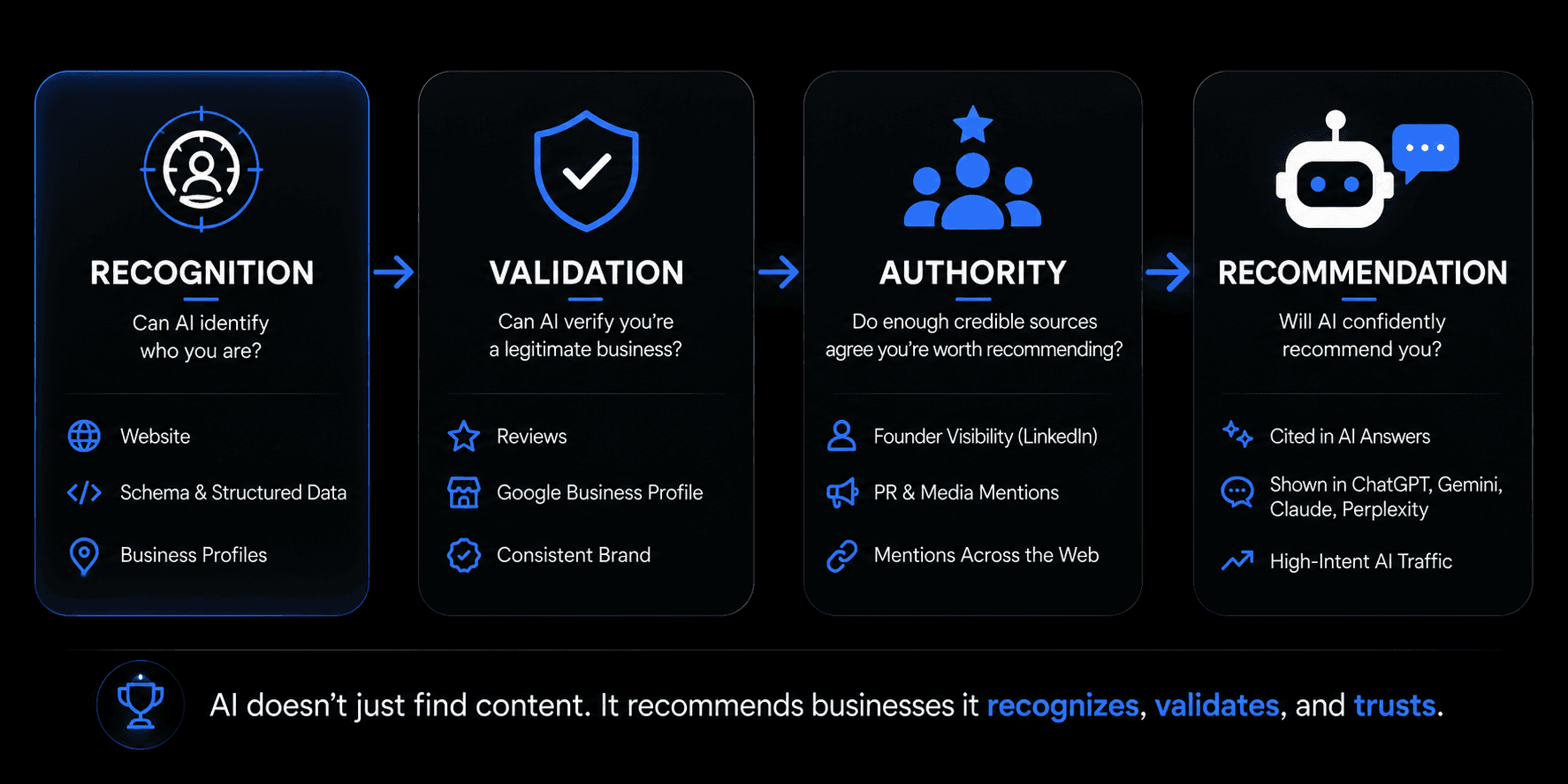
Think of every item below as helping AI move your business one step further through this framework.
I've organized this by what moves the needle fastest. Not by topic, not alphabetically. Do Tier 1 before you touch anything else.
Tier 1: Do These This Weekend
These are high-impact and fast to complete. Most take under an hour. Do them in order. They build on each other.
1. Check your robots.txt for AI crawler blocks.
robots.txt is a file on your website that tells search engines and AI tools what they're allowed to read. Your web developer or hosting platform (WordPress, Squarespace, Wix) can find and edit it in minutes.
If you use Cloudflare, you may already be blocking every AI crawler without realizing it. In July 2025, Cloudflare changed its default to block AI crawlers automatically. Millions of sites became invisible to AI search overnight and still don't know it.
Make sure these crawlers are explicitly allowed: GPTBot, PerplexityBot, ClaudeBot, Applebot, BingBot. Forward this list to your web person if you're not handling this yourself.
2. Add Organization schema to your homepage.
Schema is a small piece of code you add to your website that tells AI systems exactly what your business is. Think of it as a business card written in a language AI can read. Your web developer can add this in under an hour, or it's built into most modern website platforms.
This is how AI systems recognize your brand as a distinct entity, not just a website. Your schema should include your name, URL, logo, a clear description, and links pointing to your LinkedIn, Google Business Profile, and Crunchbase. Without it, AI tools have to guess what your company actually is.
3. Add FAQPage schema wherever you have FAQ content.
This tells AI systems that a section of your page is a list of questions and answers, which makes it much easier for them to pull your content into an AI-generated response. Your web developer handles the technical side. Your job is writing the actual questions.
“Pages with FAQ schema are 4.2x more likely to be cited in Google AI Overviews.” (Semrush, 2026)
Write five real questions your patients or customers actually ask, not generic ones, and have your developer mark them up correctly. Validate everything using Google's Rich Results Test (free tool, just Google it).
4. Complete your LinkedIn Company Page.
LinkedIn is now the #5 most-cited source in ChatGPT, up from #11 just three months ago. Use the exact same business description on LinkedIn that appears on your homepage. Consistency across platforms is what helps AI systems recognize your brand as one coherent entity.
5. Claim your primary review platform profile.
For B2B founders: G2 is the most-cited B2B software source across LLMs, with 22 to 23% share of voice in AI responses. “Profiles on G2, Capterra, or Trustpilot increase AI citation probability by approximately 3x” (Semrush). This takes 15 minutes.
6. Register in Bing Webmaster Tools.
Microsoft launched AI Performance reporting in Bing Webmaster Tools in February 2026. It shows exactly how you appear in Copilot citations. Most founders don't know this exists. It's free and takes 20 minutes to set up.
Quick win: Items 1 through 6 can all be completed this weekend. Do them in order before moving to Tier 2.
Tier 2: Do These in the Next 30 Days
7. Restructure your top 5 pages with question-based headings.
Every H2 should be a question your audience actually asks. Put the direct answer in the first one to two sentences after the heading. AI systems extract at the passage level. A 3,000-word article might only contribute 400 words to an AI answer. Make those 400 words earn their place.
8. Add original statistics with named sources to your key pages.
“A peer-reviewed study from Princeton and Georgia Tech found that adding named statistics to content improves AI visibility by 41%.” Named is the key word. “Studies show...” does nothing. “[Specific stat] according to [Source, Year]” is what AI systems treat as credible.
9. Add expert quotes.
The same study found that named quotations improve AI visibility by 37%. One attributed quote per major section. Include the person's name, their role, and where the quote comes from.
10. Add author bylines with credentials to every piece of content.
AI systems factor in author authority when deciding what to cite. Anonymous blog posts are deprioritized. Add a full name, brief credentials, and a link to LinkedIn on every article.
11. Complete your Google Business Profile.
GBP data populates directly into AI Overviews for local and branded queries. Fill in every field, add recent photos, and respond to existing reviews. For any business with a physical location or local market, this is a direct feed into AI answers.
12. Audit your NAP consistency.
NAP stands for Name, Address, Phone. AI systems cross-reference your information across every platform to confirm you're a real, trustworthy business. Inconsistencies make them less confident about recommending you.
Your business name, address, and phone number need to be exactly the same everywhere online. If your website says “Bright Smile Dental” and your Google listing says “Bright Smile Dental LLC,” that small difference creates confusion for AI systems. You may not get cited even when you should be. Do a quick Google search of your business name and check the top five places your information appears.
13. Add Article schema to your blog posts.
This is code that tags each blog post with its title, who wrote it, and when it was published or last updated. Most WordPress, Squarespace, and Wix sites can do this automatically with a plugin or built-in setting. Ask your web person if it's already on.
It tells AI systems when your content was last updated. Perplexity fetches pages live at query time, and freshness matters. A blog post marked as updated last week ranks higher in AI answers than one with no date at all.
Tier 3: Build This Over 90 Days
14. Earn 3 to 5 press or publication mentions.
“Earned media accounts for 84% of AI citations” (Muck Rack, 25M+ links analyzed). A single mention in a mid-tier industry publication does more for your AI visibility than 50 blog posts. One pitch this month is a better use of time than five new articles.
15. Publish consistently on LinkedIn as a founder.
LinkedIn native articles in the 500 to 2,000 word range account for 50 to 66% of the platform's AI citations. Post three times per week from your personal profile. The algorithm favors people over logos. So does AI visibility.
16. Participate on Reddit. But do it right.
ChatGPT and Perplexity index Reddit heavily. Find two or three subreddits where your audience lives and answer questions as a genuine expert. Don't link to yourself unless directly asked. The goal isn't traffic. It's being associated with authoritative answers in a corpus AI systems sample constantly.
17. Collect 10 or more reviews on your primary platform.
Ask your last 10 customers this week. Reviews on G2, Capterra, Trustpilot, or Google increase citation probability directly. Volume matters alongside quality. The more real people talking about your brand, the more signal AI engines have to work with.
18. Claim your Crunchbase profile.
AI systems use Crunchbase as a reference point for company data. It takes 15 minutes. If you're a funded startup, this is non-negotiable.
19. Start YouTube.
“YouTube overtook Reddit as the #1 AI-cited social platform in 2026, appearing in 16% of LLM answers” (Adweek, 2026). You don't need a studio. Four short videos with accurate titles, descriptions, and transcripts gives you a citation surface you currently don't have.
20. Build your entity on Wikidata.
Wikidata is a free, publicly editable database that Google and AI systems use to verify whether a business or person is real and credible. Think of it as a Wikipedia entry, but structured specifically for machines to read.
If your business has meaningful public presence, a Wikidata entry connects your brand directly to Google's core knowledge database. Harder to earn than most items on this list, but it compounds in ways most other signals don't.
Tier 4: When You've Done Everything Above
21. Publish one original research study per year.
This is the highest-ROI content move for founders who can execute it. Original data earns press mentions, backlinks, and AI citations simultaneously. It takes three months to build. It earns citations for years.
22. Set up AI visibility tracking.
You need a baseline before you can measure progress. Run your 10 to 20 most important buyer queries across ChatGPT, Perplexity, Gemini, and Google weekly. Log whether you appear and where. Tools to consider: Ahrefs Brand Radar, Otterly, Profound, or Peec AI.
23. Implement the full schema suite.
Schema types are different categories of structured code that label different parts of your website. Think of them as tags that tell AI “this page is a product,” “this page is a local business,” “this section is meant to be read aloud.” Your developer handles all of this. Your job is to make sure they know it's a priority.
The main ones worth adding: LocalBusiness schema if you serve a specific area (essential for dentists, restaurants, service businesses), Product schema if you sell anything directly, and Speakable schema on short, clear content sections designed to be read aloud by Siri or Alexa. Siri is now powered by Gemini, which means voice search and AI search are increasingly the same thing.
The Founder Visibility Play No One Talks About
Most AEO articles treat this as a website problem. It isn't only a website problem.
AI systems don't just cite businesses. They cite people. Your author authority, your LinkedIn presence, your name attached to expert opinions in your field. All of it increases your company's citation probability.
One belief sits at the center of everything we do at StartGrow:
In the AI era, people trust people before they trust companies.
That's why founder visibility isn't separate from AEO.
It's one of the strongest AEO signals you can build.
A business with a recognizable expert behind it is easier for both humans and AI systems to trust than an anonymous website.
That's why we spend as much time helping founders build authority as we do optimizing websites.
If you're a dentist: when someone asks ChatGPT “who is a trusted cosmetic dentist in [your city],” AI systems look for a real human with a credible digital footprint, not just a clinic name. Your personal presence online is part of the answer.
LinkedIn jumped from #11 to #5 most-cited source in ChatGPT in three months. The founders driving that shift weren't publishing more. They were publishing more strategically.
Three things to do this week as a founder:
- Update your LinkedIn About section with the exact language your company uses on its homepage.
- Add Person schema to your website's About page and link it to your LinkedIn profile.
- Publish one LinkedIn native article this week answering a real question your customers ask ChatGPT.
Your personal brand isn't separate from your AEO strategy. For a founder, it is your AEO strategy.
A Real Example
Broworks, a Webflow SEO agency, was virtually invisible in AI search. Their content was solid. Their Google rankings were fine.
They rewrote their core pages to directly answer the questions buyers ask AI: “Who is the best Webflow SEO agency for B2B SaaS?” Instead of the questions keyword tools suggest.
Within weeks, their AI citation rate hit 68% across ChatGPT, Perplexity, and Claude.
The content hadn't gotten longer. It had gotten more extractable.
Your Week 1 Action Plan
Everything on this checklist matters. But you don't have to do it all at once.
Here's what to do this week, in order:
- Run the 2-minute audit. Know your baseline before you change anything.
- Check your robots.txt for AI crawler blocks. Fix any you find.
- Add Organization schema with sameAs links to your homepage.
- Claim one review platform profile and fill it out completely.
- Ask five customers for a review on that platform today.
That's it. Five things. This weekend.
Five years ago, every business needed a website.
Today, every business needs to become a business AI is confident recommending.
The companies that build that credibility now won't just rank higher.
They'll become the default answer.
Start with step one.
Free AI Visibility Assessment
See how visible your business is in AI search.
Score your business across ChatGPT, Claude, Gemini, and Perplexity and identify your three highest-impact next steps.
Download the Free AssessmentContinue Learning
SEO Is Not Enough: Why AEO Is the Future of Search
Research & Sources
At StartGrow, we believe strong opinions should be backed by evidence. Every claim in this article is sourced below.
- Semrush (March 2026): FAQPage schema increases AI Overview citation probability 4.2x; profiles on G2, Capterra, and Trustpilot increase citation probability approximately 3x
- Ahrefs (2026): Only 38% of AI Overview citations come from top-10 results (down from 76% in July 2025); brand mentions correlate 0.664 with AI citations vs. 0.218 for backlinks
- Aggarwal et al. / Princeton & Georgia Tech, “Generative Engine Optimization” (KDD 2024): Statistics addition improves AI visibility +41%; quotation addition improves AI visibility +37%
- CXL (2026): Average AI-cited page is 1,282 words; 53.4% of cited pages are under 1,000 words
- Muck Rack (25M+ links analyzed): Earned media accounts for 84% of AI citations
- Adweek / Superlines (2026): YouTube overtook Reddit as #1 AI-cited social platform; 16% of LLM answers cite YouTube
- Superlines (2026): LinkedIn rose from #11 to #5 most-cited source in ChatGPT, November 2025 to February 2026
- Cloudflare Blog (July 2025): Default AI crawler blocking rollout
- Bing Webmaster Tools Blog (February 2026): AI Performance reporting launch
- Limy (515M bot events), OtterlyAI, SE Ranking, ALLMO (2025 to 2026): llms.txt has near-zero impact on citation frequency for most businesses

Emily Kosko
Business & Brand Strategist